
Rare Earth Metal Targets: Nd & Pr in Magnetic Storage, Lasers, and Sensors
Rare earth metals like neodymium and praseodymium are not just for bulk magnets. When made into sputtering targets and deposited as thin films, they bring unique properties to three specific applications: magnetic storage media, solid-state lasers, and advanced sensors.
Here’s how each works, and why the material choices matter.
Magnetic Storage: High Anisotropy from Nd and Pr
Magnetic recording needs a material that holds its magnetization in a preferred direction—high magnetocrystalline anisotropy. NdFeB and PrFeB alloys do exactly that.

When you sputter a neodymium target or praseodymium target, the resulting thin film can be grown with a strong out-of-plane or in-plane texture depending on the underlayer and deposition conditions. For perpendicular magnetic recording, that high anisotropy allows bit sizes to shrink without thermal stability loss. Pr-based films sometimes outperform Nd in corrosion resistance, which matters for long-term data retention.
The principle is straightforward: the 4f electrons in these rare earths create a strongly aspherical charge distribution, driving large magnetic anisotropy at the atomic level. Translated into a device, that means smaller, more stable bits and higher areal density.
Solid-State Lasers: Optical Gain from Nd and Pr Doping
In solid-state lasers, the active medium often comes from doping a host material with rare earth ions. But for thin-film or waveguide lasers, a different approach exists: direct sputtering of rare earth metal targets to create doped oxide or fluoride layers.
Neodymium is the standard for 1064 nm and 946 nm lasing. Its 4F3/2 → 4I11/2 transition has a high branching ratio and long upper-state lifetime. Praseodymium covers visible wavelengths—about 522 nm, 607 nm, and 640 nm—which are hard to reach efficiently with other rare earths.
Using a sputtering target made from high-purity Nd or Pr gives you precise control over doping concentration and film thickness. That matters for integrated photonics or compact solid-state lasers where uniformity across the gain medium directly affects beam quality and threshold pump power.
Advanced Sensors: Magnetic and Optical Responses
Sensors based on rare earth films rely on two distinct mechanisms: magnetoresistance and photonic response.
For magnetic sensors, samarium and praseodymium alloys can be engineered into thin-film structures with large anisotropic magnetoresistance (AMR) or even giant magnetoresistance (GMR) when combined with transition metals. The principle again goes back to the 4f electrons—their spin-orbit coupling modifies scattering probabilities depending on the magnetization direction relative to the current.
For optical sensors, neodymium and praseodymium films are used in absorption-based temperature or chemical sensors. The sharp 4f-4f transitions shift predictably with temperature or local environment. A thin film sputtered from a Nd target can serve as the sensing layer in a fiber-optic probe, with a readout based on intensity or wavelength shift.
The performance advantage over conventional materials? Thermal stability. Rare earths keep their magnetic and optical properties over a much wider temperature range than typical transition metals or organic dyes.
Why Target Quality Matters
None of these applications work with low-purity or poorly controlled targets. Impurities create scattering centers, quenching sites, or magnetic inhomogeneities. Oxygen contamination in a rare earth target, for example, directly reduces the available 4f electron density and kills magnetic anisotropy.
Density and grain structure also matter. A fine, uniform grain structure produces consistent film deposition with fewer particulates. That’s especially critical for sensor and laser applications where a single defect can ruin device yield.
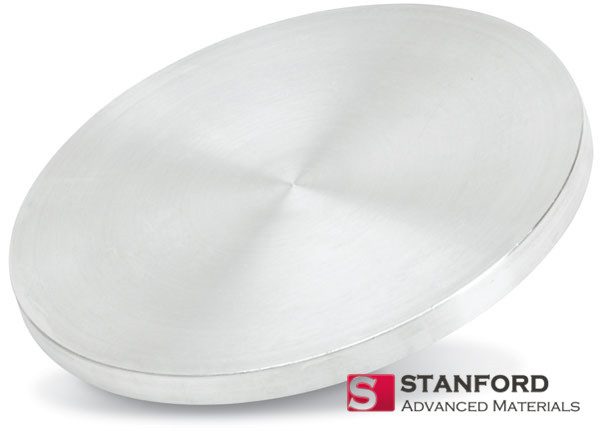
SAM: One Source for Nd, Pr, Sm, and More
If you are developing thin-film devices that rely on magnetic anisotropy, optical gain, or rare-earth-based sensing, the target is not a commodity. You need controlled purity, documented traceability, and geometries that fit your chamber.
Stanford Advanced Materials (SAM) provides neodymium, praseodymium, and other rare earth metal sputtering targets. Purity options range from 99.9% to 99.99% depending on the element. Rotatable or planar targets, custom sizes, and bonded backing plates are available per your specification.
Visit SAM’s website for technical datasheets and a quote request form.


