
Case Study: FTO Sputtering Target for TCO Thin Film Research
Introduction
A research group at a leading technical university in Switzerland needed FTO sputtering targets for transparent conductive oxide (TCO) thin film work. Two previous suppliers failed to deliver consistent doping uniformity or sufficient density. Film resistivity varied across batches, making it impossible to reproduce experimental results.
SAM supplied 4″ and 6″ FTO targets with >99% density and <10⁻³ Ω·cm resistivity. The group achieved reproducible TCO films and has since placed repeat orders.
Background
A research group at a Swiss university was developing TCO thin films for optoelectronic device applications. The process required fluorine-doped tin oxide (FTO) targets with:
- 4″ or 6″ diameter (standard sizes for their sputtering system)
- Consistent fluorine doping across the target surface
- Density above 98% to minimize particle generation
- Film resistivity below 10⁻³ Ω·cm
FTO is a known material for TCO applications, but manufacturing targets that meet all these requirements simultaneously is not trivial.
The Problem
The group had tried FTO targets from two other suppliers before contacting SAM.
Supplier A delivered targets with density below 95%. During sputtering, excessive particle formation occurred. These particles embedded in the thin films, causing defects that affected device performance.
Supplier B could not maintain consistent fluorine doping across the target surface. Film resistivity varied from one deposition run to the next—ranging from 8×10⁻⁴ to 3×10⁻³ Ω·cm. The inconsistency made it impossible to reproduce experimental results.
Two technical issues made this application difficult for standard target manufacturers:
Doping uniformity. Fluorine must be evenly distributed throughout the target. Any variation creates local differences in electrical properties. When sputtered, the resulting thin film shows resistivity variations that make it unsuitable for device fabrication.
Target density. Lower density targets produce particles during sputtering. These particles embed in the thin film, causing defects and reducing yield. For a university research lab, low yield means wasted materials and extended project timelines.
What SAM Delivered
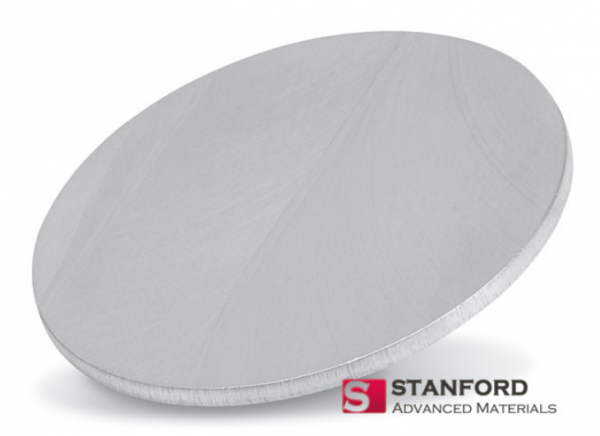
Stanford Advanced Materials (SAM) is a specialized supplier of sputtering targets including oxides, metals, and alloys for research and production applications. We supplied FTO sputtering targets manufactured to meet both the dimensional and performance requirements:
| Parameter | Value |
|---|---|
| Material | Fluorine-doped Tin Oxide (FTO) |
| Diameter | 4″ or 6″ (customer-selectable) |
| Density | >99% |
| Resistivity | <10⁻³ Ω·cm |
The targets were produced with controlled fluorine doping to ensure uniform distribution. Density exceeded the customer’s 98% requirement, measuring above 99% across all batches.
Outcome
The research group ordered a 4″ target for initial testing. After confirming performance, they placed a second order for a 6″ target. A third order followed for two 4″ targets and one 6″ target for ongoing projects.
Film resistivity measured consistently <10⁻³ Ω·cm across multiple deposition runs. The research group confirmed that the doping uniformity was sufficient to produce reproducible TCO films for device fabrication.
Summary
FTO sputtering targets for TCO research need two things: uniform fluorine doping and high density (>98%). Miss either, and film resistivity becomes inconsistent—sometimes too high for device applications, sometimes varying from batch to batch.
SAM supplies FTO targets that meet both requirements, with density above 99% and resistivity <10⁻³ Ω·cm.
Contact us today if you need sputtering targets for your research or production application.


