
Ductile-to-Brittle Transition Temperature: The Cold Truth About Metals
Drop the temperature enough, and some metals stop being metals.
No yielding. No warning. Just fracture — at the speed of sound.
That threshold is the Ductile-to-Brittle Transition Temperature (DBTT). If you’re designing for low-temperature service — LNG storage, Arctic structures, deep-sea equipment, aerospace — DBTT isn’t a detail. It’s where you start.
For sputtering targets, DBTT matters too. The same nickel alloys, stainless steels, and aluminum that go into cryogenic vessels also go into your deposition chamber. A target that operates near or below its DBTT can crack during thermal cycling — leading to particle generation, process instability, and scrapped runs. Understanding DBTT helps you choose targets that perform reliably, whether you’re sputtering at cryogenic temperatures or handling targets in cold environments.
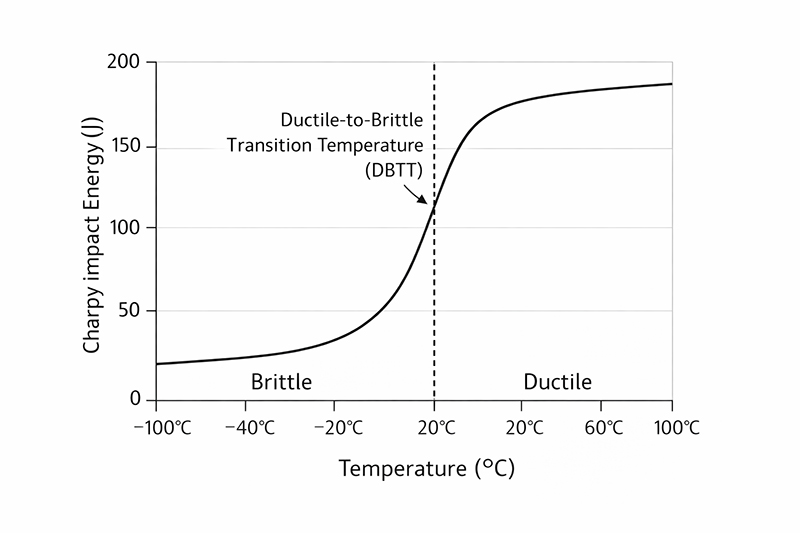
1. DBTT: What It Is and Why It Matters
DBTT is the temperature where fracture mode changes from ductile (plastic deformation) to brittle (cleavage fracture). Below this point, a part can fail before reaching yield strength. No visible deformation. No warning.
Why engineers care:
-
Pressure vessel codes (ASME, EN) require impact testing below certain temperatures.
-
Brittle fractures propagate fast — catastrophic and unpredictable.
-
Charpy V-notch testing (ASTM E23) is how DBTT gets qualified.
*The Titanic’s hull steel had a DBTT around 0°C. The North Atlantic was -2°C. Some lessons cost lives.
2. DBTT by Application
| Environment | Temperature | DBTT Requirement |
| Arctic structures | -40°C to -60°C | < -50°C |
| LNG storage | -162°C | < -170°C |
| Deep-sea | 4°C to -20°C | < -30°C (with margin) |
| Aerospace (LH₂) | -253°C | < service temp |
| Polar shipping | -30°C to -50°C | < -40°C (hull plates) |
Rule of thumb: DBTT should sit at least 10–20°C below your minimum service temperature.
3. How Common Metals Behave at Low Temperature
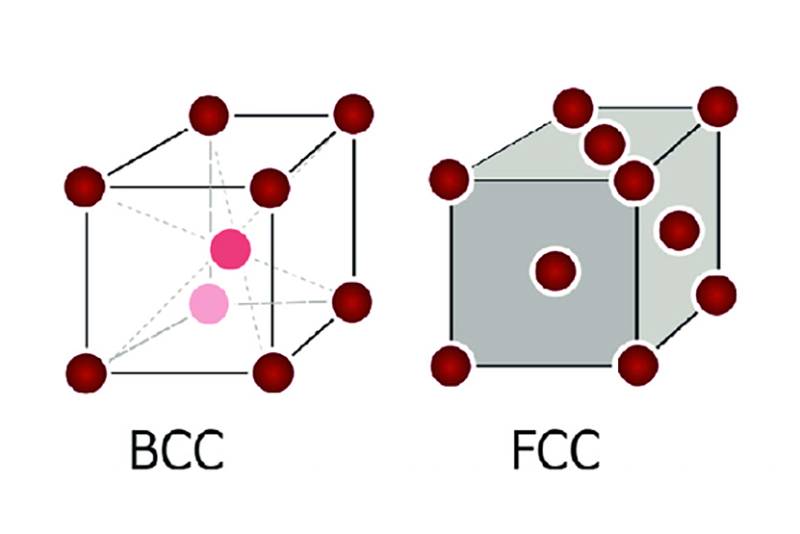
Whether a metal has a DBTT comes down to crystal structure.
Face-centred cubic (FCC) metals have no ductile-to-brittle transition. They stay ductile all the way down to absolute zero. This group includes:
-
Austenitic stainless steels (304/L, 316/L)
-
Nickel alloys (Alloy 600, 625, 718)
-
Aluminium alloys (5083, 6061)
With these, low-temperature design is simple: toughness doesn’t drop with temperature.
Body-centred cubic (BCC) metals always have a DBTT. The transition temperature depends on composition, grain size, and processing. This group includes:
-
Carbon steels (A36, 1020) — DBTT typically -20°C to +20°C, not for use below -20°C
-
Low-temperature carbon steels (A516 Gr.70 normalised) — DBTT -40°C to -50°C, usable to -45°C
-
Ferritic stainless steels (410, 430) — DBTT +10°C to +50°C, avoid for low temp
-
Tungsten — DBTT +200°C to +400°C, brittle even when hot
-
Beryllium — DBTT +100°C to +200°C, brittle at room temp
Titanium alloys sit in between. Keep oxygen under control (<0.2 wt%) and they perform well at low temperature. Let oxygen creep up and DBTT rises fast — 50–100°C per 0.1 wt% O.
4. What Shifts DBTT?
DBTT isn’t fixed by chemistry alone. It moves with microstructure.
Alloying elements
-
Nickel: Lowers DBTT in steels — roughly 10–15°C per 1% Ni. That’s why we have 3.5%, 5%, and 9% nickel steels.
-
Carbon and nitrogen: Raise DBTT. Interstitials lock dislocations at low temperature.
-
Oxygen: In titanium and refractory metals, 0.1–0.2 wt% can push DBTT up by 50–100°C.
Grain size
-
Finer grains = lower DBTT. Grain boundaries stop cleavage cracks.
-
Going from ASTM 5 to ASTM 10 grain size can drop DBTT by 20–40°C in carbon steels.
Heat treatment
-
Normalising: Refines grains, lowers DBTT.
-
Quench and temper: Lower DBTT than pearlite at same strength.
-
Annealing: Coarse grains = higher DBTT. Not for low temp.
-
Stress relief: Can embrittle some steels in the 500–600°C range.
Processing
-
TMCP: Produces ultra-fine grains, lowers DBTT without extra alloys.
-
Cold work: Raises DBTT. Dislocations get in the way of ductile fracture.
5. Low-DBTT Materials: What We Supply as Sputtering Targets
The materials below are available as sputtering targets — rotary, planar, or custom sizes — with full traceability and Charpy impact data where required.
Carbon Steels (to -60°C)
| Grade | DBTT | Application |
| ASTM A516 Gr.70 (normalised) | -45°C | Pressure vessels |
| ASTM A537 Class 2 | -60°C | Offshore platforms |
| 3.5% Ni (ASTM A203) | -100°C | Ethylene, methane service |
Austenitic Stainless (No DBTT)
| Grade | Low-Temp Performance | Application |
| 304/L | Excellent to -269°C | LNG piping, cryogenic vessels |
| 316/L | Excellent to -269°C | Marine low-temp, corrosion-resistant |
| 321/347 | Excellent to -269°C | Welded structures |
Nickel Alloys (No DBTT)
| Grade | Low-Temp Performance | Application |
| Alloy 200/201 | Excellent to -269°C | Cryogenic, caustic |
| Alloy 600 | Excellent to -269°C | Instrumentation |
| Alloy 625 | Excellent to -269°C | Deep-sea, aerospace |
Aluminium (No DBTT)
| Grade | Low-Temp Performance | Application |
| 5083-O | Excellent to -269°C | LNG tanks, shipbuilding |
| 6061-T6 | Excellent to -269°C | Structural, piping |
6. How to Select (Quick Summary)
Step 1: Find your minimum service temperature.
Step 2: Add 10–20°C safety margin.
Step 3: Pick material family based on target:
-
Above -50°C → Normalised carbon steel (A516, A537)
-
-50°C to -100°C → 3.5% Ni steel
-
-100°C to -196°C → 9% Ni steel or austenitic stainless
-
Below -196°C → Austenitic stainless, nickel alloys, aluminium
Step 4: Specify Charpy impact testing per ASTM E23.
Step 5: Check actual DBTT on the mill certificate. Never assume.
About Stanford Advanced Materials (SAM)
For over 30 years, SAM has supplied high-performance metals and alloys for demanding applications — from cryogenic infrastructure to thin-film deposition.
We supply the materials above in sputtering target form, including:
- Rotary targets for high-volume production
- Planar targets for R&D and pilot lines
- Custom sizes and bonding services
Every target comes with full traceability. Charpy impact data and oxygen content certification are available where required.
Need a target for low-temperature deposition or cold-environment handling?
Browse our sputtering targets by material — or contact us for help selecting a target with the right DBTT characteristics for your process.


