
PVD vs. DLC Coatings: A Technical Comparison for Engineers
For design engineers and materials scientists, choosing a surface treatment often decides how a component performs in real use. Physical Vapor Deposition (PVD) and Diamond-Like Carbon (DLC) coatings are two effective options. They are often cited for dramatically extending component life.
While they share the goal of surface enhancement, treating them as interchangeable solutions is a common misstep. They are fundamentally different in composition and behavior.
What is PVD? The Process, Not Just the Product
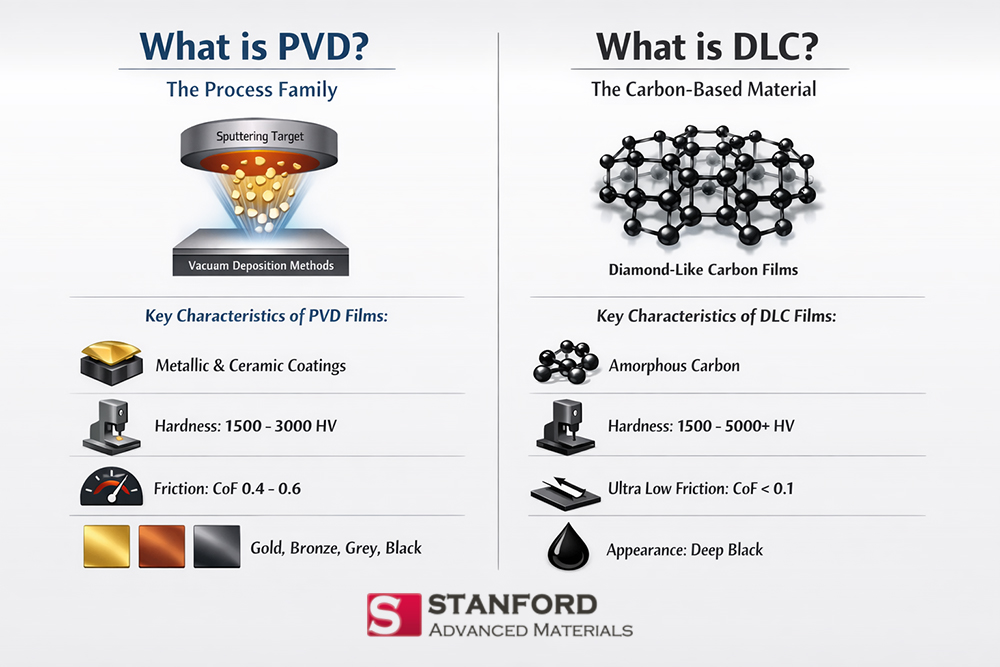
It’s crucial to understand that PVD is a process family, not a single material. It refers to a range of vacuum deposition methods—such as sputtering or evaporation—where a solid material is vaporized in a high-vacuum environment and then condensed onto a substrate to form a thin, highly durable film.
The strength of a PVD coating lies in its precursors. The purity and consistency of the source materials—the sputtering targets and evaporation pellets—directly dictate the final film’s integrity. At Stanford Advanced Materials (SAM), we supply these high-purity metals and compounds. This helps ensure the deposition process starts with a strong base of quality. This is critical for semiconductors, advanced optics, and precision tooling.
Key Characteristics of PVD Films:
- Composition: Metallic or ceramic (e.g., Titanium Nitride (TiN), Chromium Nitride (CrN), Aluminum Titanium Nitride (AlTiN)).
- Hardness: Typically ranges from 1500 to 3000 HV, providing robust defense against abrasive wear.
- Friction: Generally low, with a coefficient of friction (CoF) often between 0.4 and 0.6, though this varies with the specific material.
- Aesthetic Range: Broad spectrum, from decorative golds and bronzes to functional greys and blacks.
What is DLC? A Material Defined by Its Properties
DLC, or Diamond-Like Carbon, is best understood as a material family defined by its exceptional properties. It’s an amorphous carbon structure that contains a significant proportion of sp³ hybridized bonds, the same bonds that give diamond its extreme hardness. While DLC films can be deposited using PVD methods (like sputtering a graphite target), they are distinct because of their carbon-based nature.
Key Characteristics of DLC Films:
- Composition: Amorphous carbon (a-C), often hydrogenated (a-C:H) or doped with other metals to tailor properties.
- Hardness: Can range from 1500 to over 5000 HV, with tetrahedral amorphous carbon (ta-C) reaching the upper limits.
- Friction: Extremely low. A hydrogenated DLC can achieve a CoF below 0.1 in inert environments, making it ideal for unlubricated sliding contacts.
- Aesthetic Range: Almost exclusively a dark grey to deep black, which is a visual hallmark of a high-carbon content.
Head-to-Head: Making the Right Choice
The decision often comes down to a trade-off between extreme frictional performance and broader material versatility.
| Feature | PVD (e.g., TiN, CrN, AlTiN) | DLC (Diamond-Like Carbon) |
|---|---|---|
| Primary Strength | Adhesion & Toughness: Exceptional bonding to metallic substrates, making them ideal for high-load, high-temperature forming tools. | Lubricity & Hardness: Unmatched low friction and extreme surface hardness, perfect for precision moving parts. |
| Typical Hardness | 1500 – 3000 HV | 1500 – 5000+ HV (ta-C grades) |
| Coefficient of Friction | ~0.4 – 0.6 | < 0.1 – 0.2 (a key differentiator) |
| Max Service Temp | Often higher (~700-900°C for some nitrides) | Generally lower (~300-400°C, depending on doping) |
| Process Sensitivity | A physical process; film properties are highly dependent on chamber parameters and target purity. | A material science challenge; properties are highly sensitive to deposition method (PVD, CVD) and hydrogen content. |
| Cost Consideration | More cost-effective for high-volume coating of tools and components. | Typically more expensive due to process complexity and higher material costs. |
When to Specify PVD
Choose a PVD coating when your primary concerns are:
- High-Temperature Wear: For die-casting molds or cutting tools that experience significant thermal cycling.
- Corrosion Protection: Dense, inert ceramic layers like CrN provide a strong barrier against chemical attack.
- Specific Material Properties: When you need the electrical conductivity of a metal film or the specific color of a decorative coating.
- Process Scalability: When you need a repeatable, well-understood industrial process for large batches.
The success of PVD in these roles hinges on input materials. SAM provides the high-purity sputtering targets and evaporation materials that ensure dense, defect-free films, maximizing the performance and uptime of your coating systems.
When to Specify DLC
Choose a DLC coating when your application is limited by:
- Stiction or High Friction: In MEMS devices, engine components (piston pins), or bearings, DLC can eliminate the need for liquid lubricants.
- Sliding Wear: For components that experience galling or adhesive wear, the ultra-hard, smooth surface of DLC provides exceptional protection.
- Abrasive Environments: In hard drives or textile machinery, DLC’s extreme hardness resists fine-particle abrasion.
Conclusion: A Strategic Decision, Not a Competition
PVD and DLC are not competing technologies; they are complementary solutions for different performance regimes. PVD is a broad-process toolkit for applying durable, versatile coatings. DLC is a specialized, high-performance material optimized for low friction and extreme hardness.
Many engineers find that the choice becomes clear once they quantify their application’s specific friction and temperature requirements. For those whose path leads to PVD, the quality of the journey starts with the source materials. Stanford Advanced Materials (SAM) is committed to providing precision materials for advanced engineering solutions. It supports innovation across the semiconductor, industrial, and research sectors.


