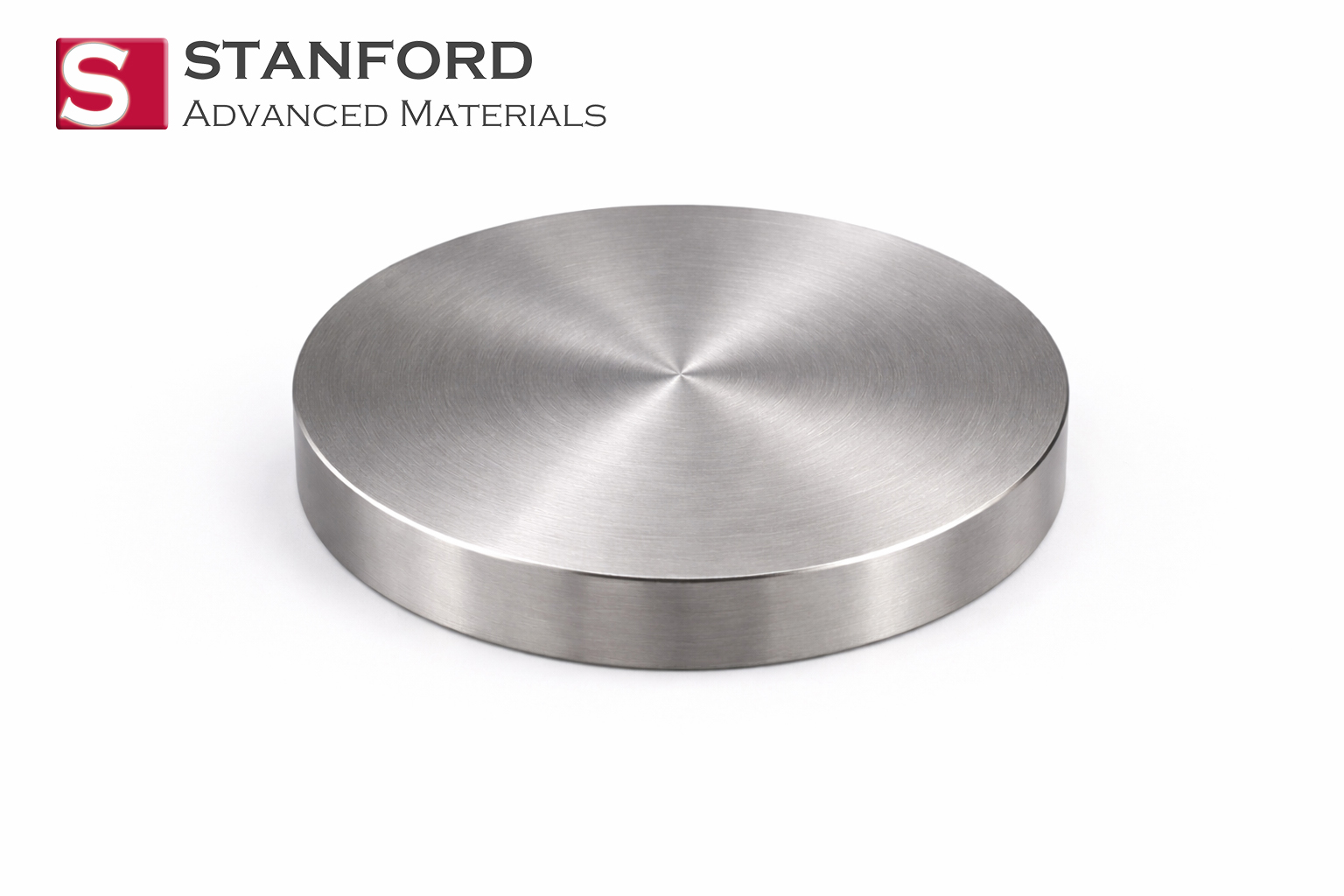
Our Nickel Vanadium (NiV) Rotary Sputtering Targets are designed for depositing precise alloy films, primarily serving as advanced diffusion barriers in semiconductor interconnects and as components in wear-resistant and decorative coatings. The addition of vanadium to nickel modifies grain structure and thermal stability, enhancing film performance.
| Material | Nickel Vanadium Alloy (NiV) |
| Typical Composition | Customizable (e.g., Ni-5V, Ni-10V at.%) |
| Purity | ≥ 99.9% (Metal Basis) |
| Form | Rotary Sputtering Target (Tubular) |
Key Advantage: Vanadium addition refines nickel’s grain structure, improving film density and barrier properties against copper diffusion, while also enhancing hardness and corrosion resistance for functional coatings.
Customization: Ni:V atomic ratio, tube dimensions (OD, ID, Length), and bonding fully customizable.
Typical Applications: Diffusion barrier/liner layers in semiconductor interconnects, wear-resistant tribological coatings, decorative PVD finishes, and catalyst research.
For detailed evaluation and procurement (Standard Reference: ST11205).
| Parameter | Specification / Typical Value |
|---|---|
| Material | Nickel Vanadium Alloy (NiV) |
| Composition Range | Fully customizable (e.g., 1-20 at.% V) |
| Purity (Metal Basis) | ≥ 99.9% |
| Key Microstructural Effect | Grain refinement of nickel matrix |
| Standard Shape | Tubular (Rotary Target) |
| Key Dimensions | Custom OD, ID, Length |
| Sputtering Method | DC Magnetron (Optimized) |
| Bonding/Integration | Compatible with rotary cathode systems |
| Certification | Certificate of Composition (CoC) provided |
In semiconductor metallization, as feature sizes shrink, preventing copper diffusion into dielectrics is critical. NiV alloys (with ~5-10% V) are investigated as a single-material barrier/liner. Vanadium effectively pins grain boundaries in nickel, creating a denser, more amorphous-like film structure that offers superior diffusion barrier performance at reduced thickness compared to pure nickel, potentially enabling further scaling.
Beyond electronics, NiV films provide functional surface properties:
Nickel-vanadium alloys are studied as catalysts for various reactions, including hydrocarbon reforming and hydrogenation. Sputtered NiV thin films provide a well-defined, compositionally controlled model system for high-throughput catalyst screening and fundamental studies of synergistic effects between the two metals.
For semiconductor production or large-area coating, uniformity is key:
We verify the precise Ni:V ratio using Inductively Coupled Plasma (ICP) analysis. Microstructural homogeneity is checked via microscopy to ensure the vanadium is evenly distributed, which is crucial for predictable and uniform film properties, especially in barrier layer applications.
Get a Formal Quote or Composition Consultation
To specify the optimal NiV alloy for your process, please provide: