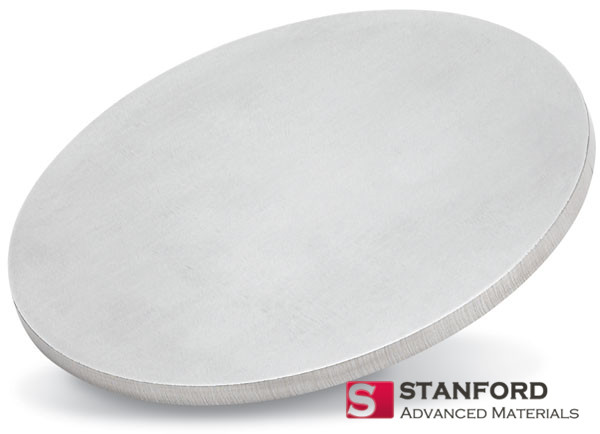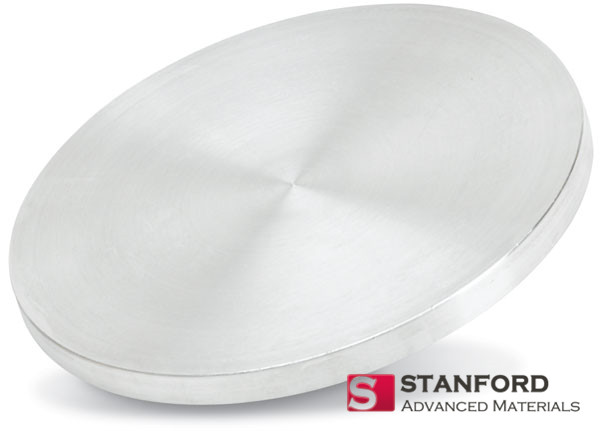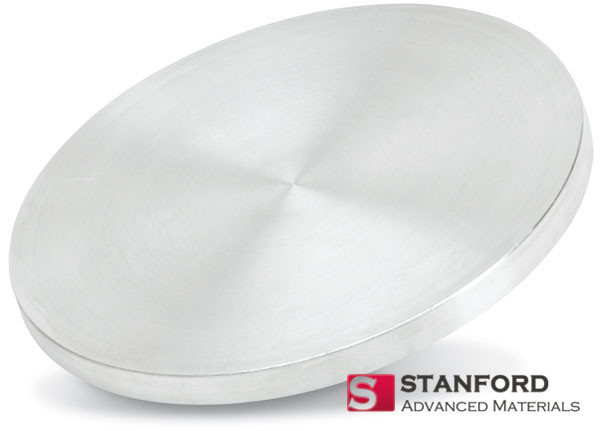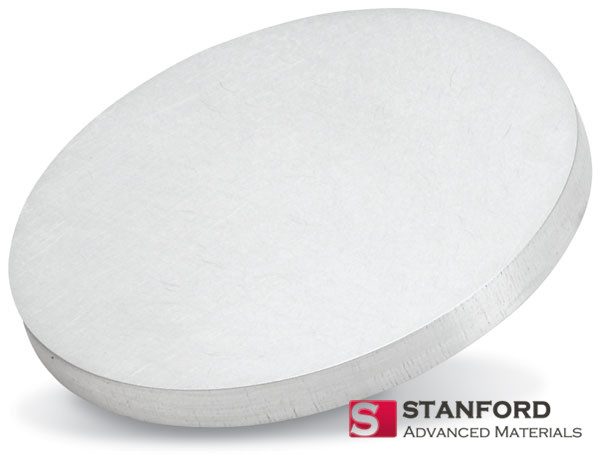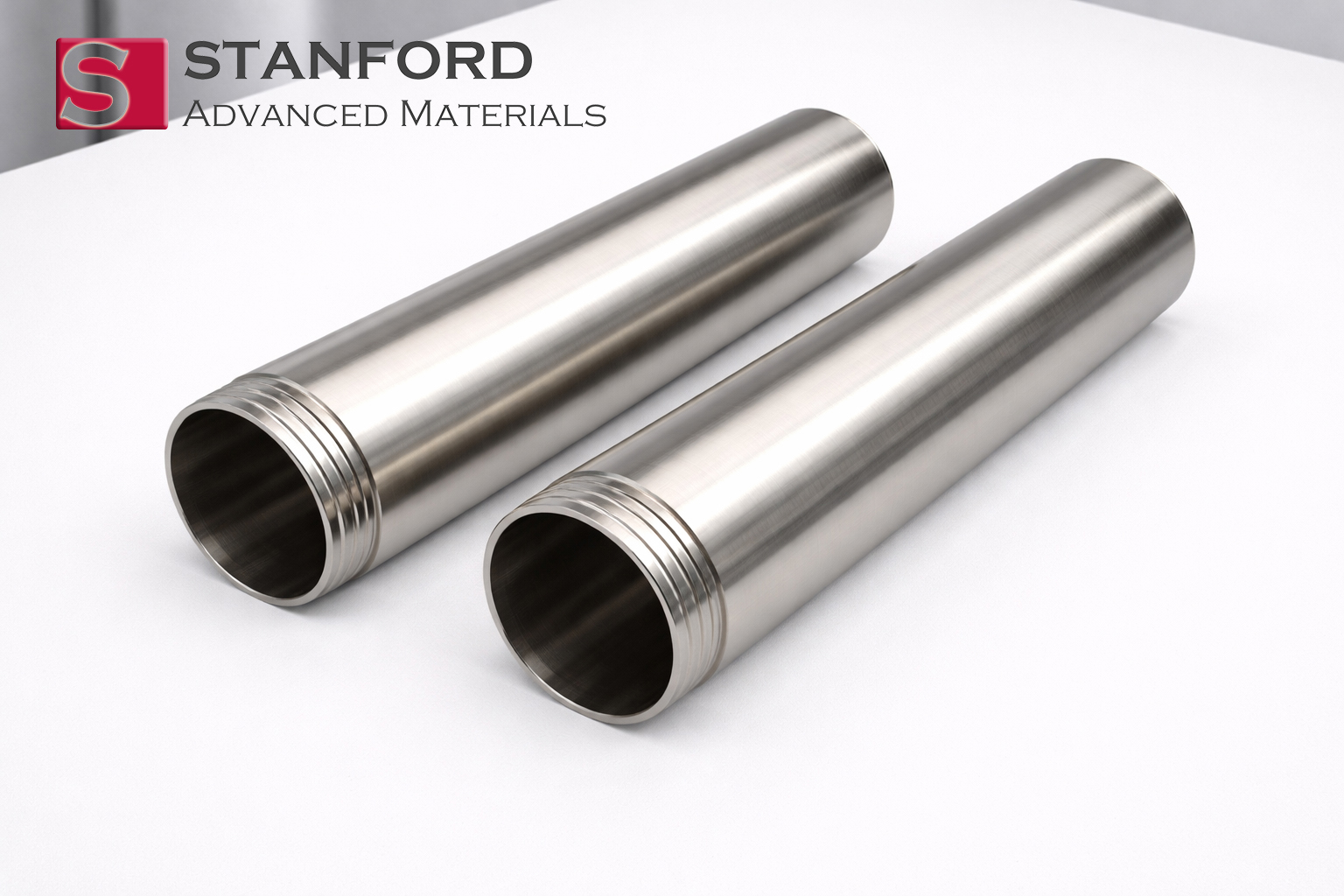
Our Nickel Chromium (NiCr) Rotary Sputtering Targets deposit high-performance alloy films for precision thin-film resistors and micro-scale heating elements. The standard 80% Ni / 20% Cr composition provides optimal resistivity, temperature stability, and process compatibility for advanced electronics.
| Material | Nickel Chromium Alloy (NiCr) |
| Standard Composition | Ni-80%, Cr-20% (by weight, customizable) |
| Purity | ≥ 99.9% (Metal Basis) |
| Form | Rotary Sputtering Target (Tubular) |
Key Advantage: Uniform, high-purity source for co-sputtering Ni and Cr, enabling precise control over critical film properties like resistivity and TCR.
Customization: Ni/Cr ratio, tube dimensions (OD, ID, Length), and bonding fully customizable.
Typical Applications: Thin-film resistors & networks, on-chip heaters, strain gauges, corrosion-resistant coatings.
For detailed evaluation and procurement (Standard Reference: ST11202).
| Parameter | Specification / Typical Value |
|---|---|
| Material | Nickel Chromium Alloy (NiCr) |
| Standard Composition | Ni-80wt%, Cr-20wt% |
| Composition Flexibility | Adjustable Ni:Cr ratio per request |
| Purity (Metal Basis) | ≥ 99.9% |
| Density | ~8.4 g/cm³ (Alloy dependent) |
| Electrical Resistivity (Bulk Alloy) | ~108 µΩ·cm (for Ni-20Cr) |
| TCR (Typical Film) | Low, near-zero (can be tuned with composition) |
| Standard Shape | Tubular (Rotary Target) |
| Key Dimensions | Custom OD, ID, Length |
| Sputtering Method | DC Magnetron (Optimized) |
| Bonding/Integration | Compatible with rotary cathode systems |
| Certification | Certificate of Composition (CoC) provided |
1. The Precision Workhorse for Electronic Components
NiCr (especially 80/20) is the dominant material for thin-film resistors due to its:
Controllable Resistivity: Offers a suitable sheet resistance range for integrated and hybrid circuits.
Low & Stable TCR: Can achieve a TCR very close to zero (±25 ppm/°C or better), essential for precision analog and measurement circuits.
Excellent Long-Term Stability: Films exhibit minimal drift over time and under load, ensuring device reliability.
Good Adhesion & Etchability: Compatible with standard semiconductor and micro-fabrication processes.
2. Why Rotary Targets for NiCr Deposition?
For manufacturing resistor networks on large-area substrates or high-volume wafer production, uniformity is non-negotiable. Rotary targets provide:
Exceptional Compositional Uniformity: Ensures consistent Ni:Cr ratio across the entire substrate, directly translating to uniform sheet resistance and TCR—a key yield driver.
High Material Utilization & Throughput: Essential for cost-effective production of these widely used components.
Stable Deposition: The continuous rotation promotes even target erosion and stable plasma conditions, critical for reproducible film properties.
3. Beyond Resistors: Versatile Functional Films
Micro-Heaters: Used in MEMS-based gas sensors, micro-fluidic devices, and thermal actuators.
Corrosion-Resistant Coatings: Provides a hard, durable, and often decorative finish (stainless-steel-like appearance) for consumer goods and industrial parts.
Diffusion Barriers: Can serve as an adhesion/barrier layer in some metallization schemes.
Given the sensitivity of electrical properties to composition, we employ X-ray Fluorescence (XRF) or Inductively Coupled Plasma (ICP) analysis to verify the precise Ni:Cr ratio. Homogeneity is confirmed via cross-sectional SEM/EDS mapping. This ensures the target delivers a consistent sputter flux, enabling the deposition of films with tightly controlled and predictable electrical characteristics.
Expertise in Precision Alloy Deposition: We understand the critical link between target composition and thin-film electronic properties.
Supplier to the Electronics Industry: We provide materials for both R&D and volume production of passive components and sensors.
Custom Composition Capability: We can tailor the Ni/Cr ratio to meet specific TCR or resistivity targets for your application.
Get a Formal Quote or Composition Data Sheet
To specify the optimal NiCr alloy for your component fabrication, please provide:
Desired Nickel to Chromium ratio (standard 80/20 or other).
Rotary target dimensions or your cathode model.
Primary application and key film property targets (e.g., target sheet resistance, TCR).