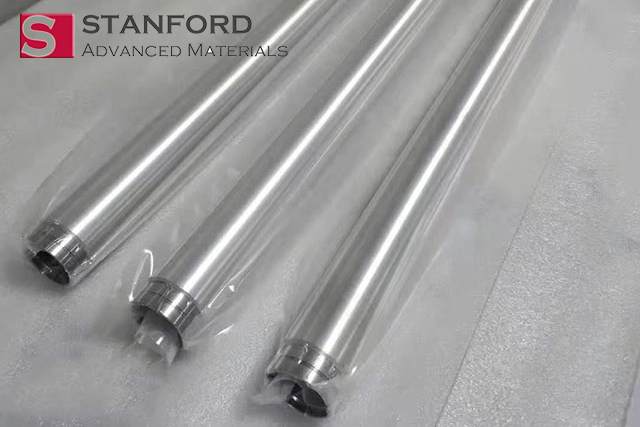
High-Efficiency Indium Targets for Large-Area and Volume Coating
| Material | Indium (In) |
| Purity | ≥ 99.99% (4N) Standard |
| Form | Rotary Sputtering Target (Tubular) |
| Key Benefit | High Uniformity & Material Utilization for Large Areas |
Key Advantage: The rotary geometry ensures extremely uniform erosion, enabling consistent indium flux across large-area substrates—a critical factor for maintaining homogeneous film properties in display and PV manufacturing.
Customization: Purity (up to 99.999%), tube dimensions (OD, ID, Length), and bonding fully customizable.
Typical Applications: Large-area ITO co-sputtering for displays & touch panels, transparent conductive layers for flexible electronics, volume production of semiconductor contacts, and research on scalable indium film processes.
Our Indium Rotary Sputtering Targets are engineered for productivity, combining the essential ultra-high purity of indium with the superior uniformity and material efficiency of a rotary design. This configuration is critical for cost-effective deposition of indium over large substrates, such as display panels or solar modules, particularly in processes like reactive co-sputtering for ITO.
For detailed evaluation and procurement (Standard Reference: ST11191).
| Parameter | Specification / Typical Value |
|---|---|
| Material | Indium (In) |
| Purity (Standard) | ≥ 99.99% (4N) |
| Available Purity | 99.99%, 99.995%, 99.999% |
| Density | ≥ 7.28 g/cm³ |
| Melting Point | 156.6 °C |
| Electrical Resistivity | ~8.4 µΩ·cm |
| Thermal Conductivity | 82 W/(m·K) |
| Standard Shape | Tubular (Seamless Construction) |
| Key Dimensions | Custom OD, ID, Length |
| Sputtering Method | DC Magnetron (Low-Power Optimized) |
| Cooling Requirement | Critical – Requires efficient cathode cooling to prevent target melting/deformation. |
| Bonding/Integration | Designed for secure mounting on cooled rotary mandrels. |
| Certification | Certificate of Analysis (CoA) with GDMS/ICP-MS data provided |
1. Enabling Large-Area ITO Deposition via Co-Sputtering
While ceramic ITO targets are common, reactive co-sputtering from separate In and Sn metal targets offers superior process control for tuning film composition and properties. For coating Gen 8+ display glass or large flexible webs, a rotary indium target is essential:
2. The Critical Importance of Thermal Management
Indium’s low melting point (156.6°C) presents a unique engineering challenge for rotary targets, which operate under high plasma power. Our design and manufacturing process prioritizes:
3. Application-Specific Guidance
Beyond standard purity analysis via GDMS/ICP-MS, we perform rigorous ultrasonic inspection to ensure the integrity of the tubular structure and its bond to any backing interface (if pre-bonded). Dimensional verification (concentricity, straightness, wall thickness uniformity) is critical to prevent vibration and ensure even cooling. We guarantee the target meets the mechanical and thermal specifications required for reliable integration into industrial rotary cathodes.
Get a Formal Quote or Technical Consultation
Indium rotary targets require careful system matching. For a precise quote and technical review, please provide: