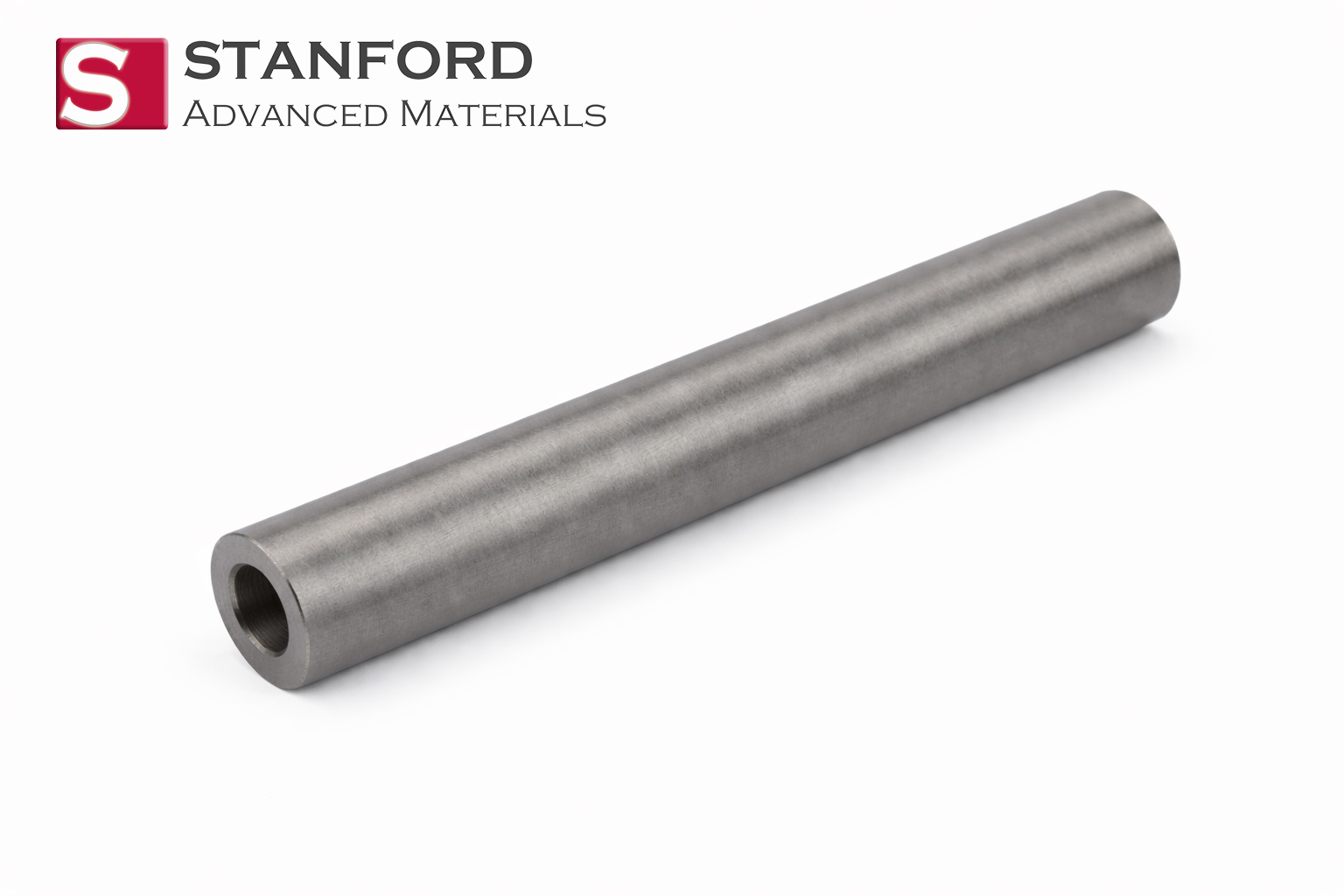
Our Iron Cobalt Boron (CoFeB) Rotary Sputtering Targets are specifically engineered for the high-volume production of advanced magnetic thin films, particularly the free and pinned layers in Magnetic Tunnel Junctions (MTJs) – the core component of Magnetoresistive Random-Access Memory (MRAM) and high-sensitivity sensors.
| Material | Cobalt Iron Boron Alloy (CoFeB) |
| Standard Composition | Co₆₀Fe₂₀B₂₀ (at.%) |
| Purity | ≥ 99.9% (Metal Basis) |
| Form | Rotary Sputtering Target (Tubular) |
Key Advantage: Precise Co:Fe:B ratio and exceptional homogeneity are critical for achieving the high tunnel magnetoresistance (TMR) ratio and consistent switching properties required in MRAM devices.
Customization: Composition (Co/Fe/B ratios), tube dimensions (OD, ID, Length), and purity fully customizable.
Typical Applications: MTJ layer deposition for MRAM chips, spintronic logic devices, magnetic sensors (TMR, GMR), and read-heads for advanced data storage.
For detailed evaluation and procurement (Standard Reference: ST11178).
| Parameter | Specification / Typical Value |
|---|---|
| Material | Cobalt Iron Boron Alloy (CoFeB) |
| Standard Composition | Co₆₀Fe₂₀B₂₀ (Atomic Percent) |
| Composition Tolerance | ± 1 at.% per element (Customizable) |
| Purity (Metal Basis) | ≥ 99.9% |
| Typical Density | ~8.1 g/cm³ |
| Magnetic Properties | Soft Magnetic (Film-dependent) |
| Standard Shape | Tubular (Rotary Target) |
| Key Dimensions | Custom OD, ID, Length |
| Sputtering Method | DC Magnetron (Optimized) |
| Crystalline State (As-Deposited Film) | Typically amorphous, crystallizes upon annealing |
| Bonding/Integration | Compatible with standard rotary cathode cooling mandrels |
| Certification | Certificate of Composition (CoC) with EDX/WDS mapping available |
1. The Material Heart of MRAM Technology
CoFeB, particularly the Co₆₀Fe₂₀B₂₀ composition, is the industry-standard material for the magnetic layers in perpendicular magnetic anisotropy (PMA) MTJs. The boron (B) content is crucial: it promotes the formation of an amorphous as-deposited film, which, upon subsequent annealing, crystallizes with a bcc (001) texture interfaced with an MgO tunnel barrier, enabling exceptionally high TMR ratios. Our target guarantees the precise stoichiometry needed for this controlled crystallization process.
2. Why Rotary Design for CoFeB?
For high-volume semiconductor production (e.g., 300mm wafer fab lines for embedded MRAM), rotary targets offer decisive advantages:
3. Application-Specific Guidance
Given the criticality of composition, we employ Vacuum Induction Melting (VIM) under inert atmosphere followed by homogenization to achieve a uniform ingot. Final composition is verified using Wavelength Dispersive Spectroscopy (WDS) or Inductively Coupled Plasma (ICP) analysis. For rotary targets, we additionally provide EDX elemental mapping on a cross-section to demonstrate radial and axial homogeneity, ensuring every segment of the tube sputters identically.
Get a Formal Quote or Composition Consultation
To discuss your CoFeB film requirements for MRAM or sensor production, please provide: