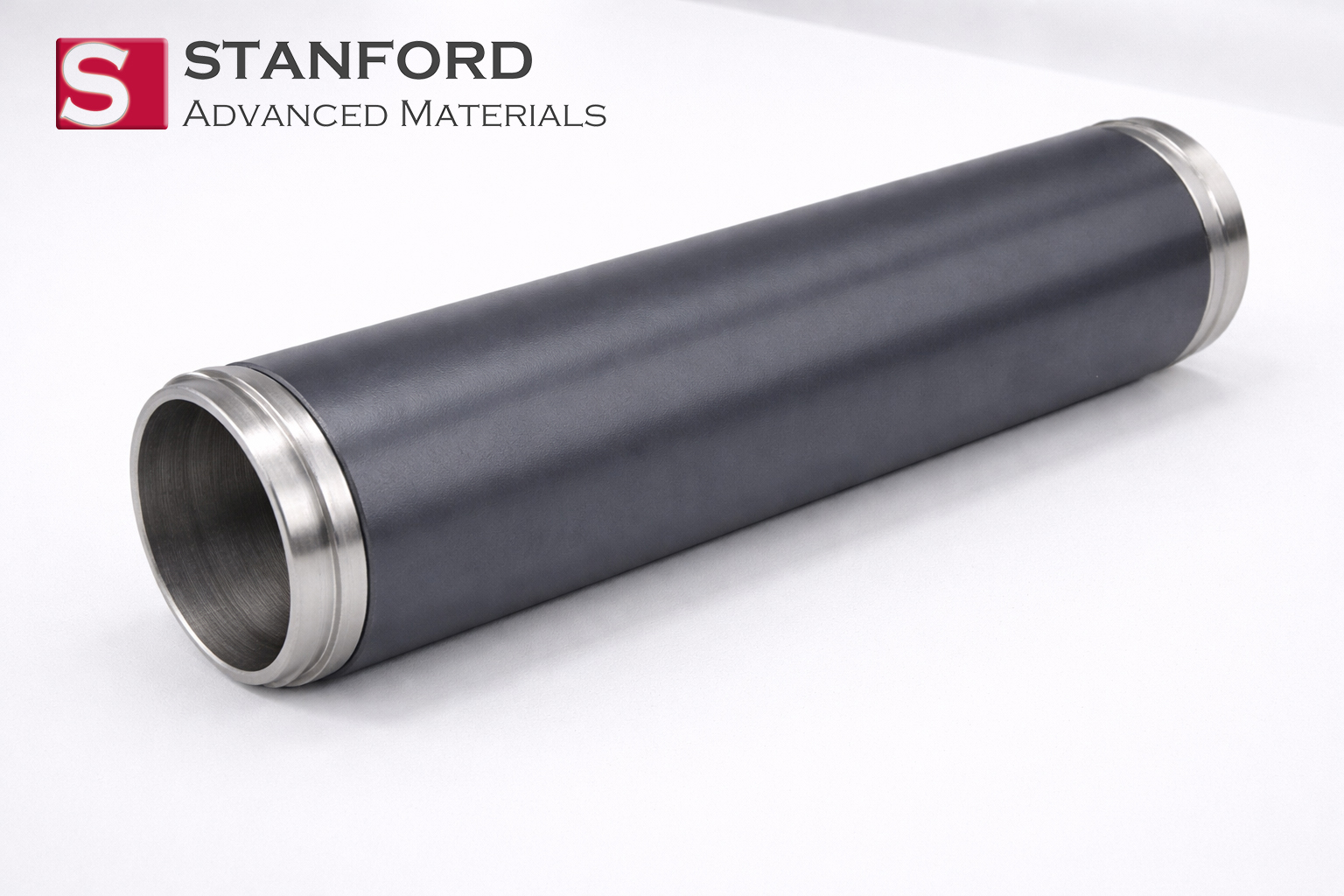
Our Niobium Oxide (NbOx) Rotary Sputtering Targets enable high-throughput deposition of films with tunable oxygen content. This allows precise control over electrical and optical properties, supporting advanced applications in smart windows, catalysis, and surface engineering.
| Material | Niobium Oxide (NbOx) |
| Key Feature | Adjustable Oxygen Stoichiometry (x) |
| Purity | ≥ 99.9% (Metal Basis) |
| Form | Rotary Sputtering Target (Tubular) |
Key Advantage: Enables deposition of films ranging from conductive sub-oxides to insulating Nb₂O₅ by adjusting target composition, offering exceptional process flexibility.
Customization: Oxygen content (O/Nb ratio), tube dimensions (OD, ID, Length), and bonding fully customizable.
Typical Applications: Electrochromic layers for smart windows, catalytic coatings, corrosion-resistant barriers, and optical thin films.
For detailed evaluation and procurement (Standard Reference: ST11200).
| Parameter | Specification / Typical Value |
|---|---|
| Material | Niobium Oxide (NbOx) |
| Composition Range | NbO, NbO₂, Nb₂O₅, or custom mixed phases |
| Purity (Metal Basis) | ≥ 99.9% |
| Density | ≥ 4.9 g/cm³ (Phase dependent) |
| Standard Shape | Tubular (Rotary Target) |
| Key Dimensions | Custom OD, ID, Length |
| Electrical Property | Tunable: Metallic (NbO) → Semiconducting (NbO₂) → Insulating (Nb₂O₅) |
| Sputtering Method | DC (for conductive phases), RF or Pulsed-DC Reactive |
| Bonding/Integration | Designed for high-power rotary cathode systems |
| Certification | Certificate of Composition (CoC) with phase analysis (XRD) provided |
1. Engineering Film Properties Through Stoichiometry
The performance of niobium oxide films is critically dependent on the oxygen-to-niobium ratio. Our targets can be fabricated to specific compositions:
NbO (x=1): Conductive, metallic properties.
NbO₂ (x=2): Semiconducting, with interesting electronic and catalytic properties.
Nb₂O₅ (x=2.5): Insulating, high refractive index, ideal for optics and electrochromics.
This allows researchers and engineers to precisely tailor film resistivity, optical absorption, and catalytic activity from a single target material platform.
2. Rotary Design for Large-Area and Industrial Coating
The rotary target format is essential for applications requiring uniformity over large substrates or high-volume throughput:
Electrochromic Device Manufacturing: For uniform coating of large-area glass for smart windows.
Catalytic Reactor Coatings: For depositing active coatings on monoliths or large surface area substrates.
Industrial Protective Coatings: For efficient, uniform application on batches of components.
3. Phase Control and Manufacturing
Achieving a homogeneous, phase-pure (or controlled mixed-phase) NbOx ceramic is a sintering challenge. We use reactive sintering or hot pressing under controlled oxygen partial pressure to lock in the desired composition and ensure high density, which is critical for stable, arcing-free sputtering.
Each batch is characterized by X-ray Diffraction (XRD) to confirm the primary phase(s) and by elemental analysis to verify the oxygen content. Density and microstructure are checked to ensure sputtering performance. This guarantees that the target delivers consistent film properties throughout its operational life.
Expertise in Non-Stoichiometric Oxides: We specialize in fabricating ceramic targets with precise control over oxygen content.
Application-Focused Solutions: We provide targets tailored for electrochromics, catalysis, and functional coatings.
Scale-Up Capability: We support both R&D and production-scale needs with rotary targets sized for industrial coaters.
Discuss Your Stoichiometry Needs & Request a Quote
To specify the optimal NbOx target for your process, please provide:
Desired oxide phase or O/Nb ratio (e.g., Nb₂O₅, NbO₂, or mixed).
Rotary target dimensions or your coating system model.
Primary application and key film property targets (e.g., resistivity, optical transmission, catalytic activity).