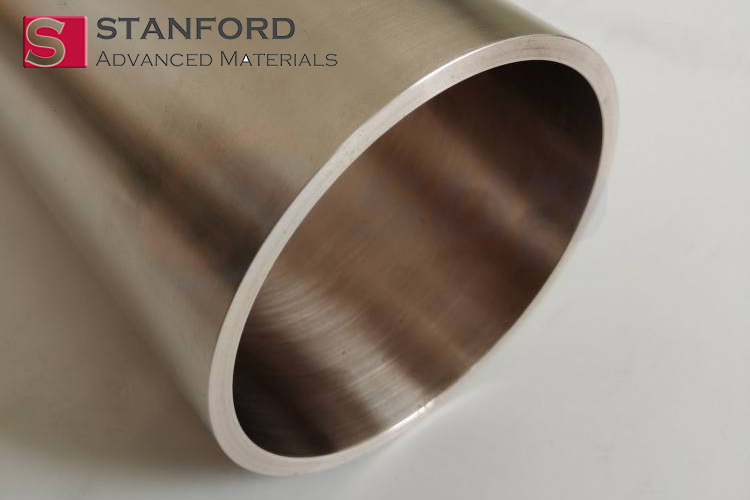
Our Copper Aluminum (CuAl) Rotary Sputtering Targets combine the excellent conductivity of copper with the favorable properties of aluminum to deposit alloy films that serve as superior interconnects, bonding layers, and transparent electrode components, especially where pure copper or pure aluminum face specific process integration challenges.
| Material | Copper Aluminum Alloy (CuAl) |
| Standard Composition | Cu-rich (e.g., Cu-1~10% Al) or Al-rich (e.g., Al-1~4% Cu) |
| Purity | ≥ 99.9% (Metal Basis) |
| Form | Rotary Sputtering Target (Tubular) |
Key Advantage: Al addition to Cu improves electromigration resistance and adhesion; Cu addition to Al enhances conductivity and thermal stability, enabling optimized film properties for specific applications.
Customization: Composition (any Cu/Al ratio), tube dimensions (OD, ID, Length), and purity fully customizable.
Typical Applications: Semiconductor bonding pads & redistribution layers (RDLs), large-area display (TFT) gate/data lines, solar cell contacts, and diffusion barrier/seed layers.
For detailed evaluation and procurement (Standard Reference: ST11182).
| Parameter | Specification / Typical Value |
|---|---|
| Material | Copper Aluminum Alloy (CuAl) |
| Standard Compositions | Cu-1%Al, Cu-2%Al, Al-1%Cu, Al-2%Cu (Custom ratios available) |
| Purity (Metal Basis) | ≥ 99.9% |
| Density | ~5.5 – 8.5 g/cm³ (Alloy dependent) |
| Electrical Resistivity (Bulk) | Slightly higher than pure Cu/Al, tunable (e.g., Cu-2%Al: ~2.0 µΩ·cm) |
| Thermal Conductivity | High (200-350 W/(m·K), alloy dependent) |
| Standard Shape | Tubular (Rotary Target) |
| Key Dimensions | Custom OD, ID, Length |
| Sputtering Method | DC Magnetron (Optimized) |
| Bonding/Integration | Designed for use with rotary cathode cooling mandrels |
| Certification | Certificate of Composition (CoC) provided |
1. Strategic Alloying for Semiconductor and Display Integration
Pure metals have limitations in advanced manufacturing. CuAl alloys offer engineered solutions:
Cu-rich (Cu-1~10%Al): The small Al addition significantly improves electromigration resistance and adhesion to dielectrics compared to pure Cu, addressing reliability concerns in fine-line interconnects, especially for bonding pads and under-bump metallization (UBM).
Al-rich (Al-1~4%Cu): Historically used in semiconductor metallization (Al-Si-Cu), the Cu addition refines grain structure, increases resistance to stress-induced voiding, and slightly improves conductivity over pure Al. In displays, it can offer a balance of conductivity, etchability, and cost.
2. Why Rotary for CuAl Alloys?
For large-area or high-throughput applications like display panel manufacturing or wafer-level packaging, rotary targets provide critical benefits:
3. Application-Specific Guidance
Achieving a homogeneous solid solution of Cu and Al (which have limited mutual solubility) requires precise rapid solidification or powder metallurgy techniques. We verify composition via ICP-OES and confirm elemental homogeneity using SEM/EDS mapping across the target’s cross-section. This ensures the sputtered film’s composition matches the target specification throughout its operational life.
Get a Formal Quote or Composition Consultation
To specify the optimal CuAl alloy for your process, please provide:
Submit your review | |
Our lab ordered an Al-rich (Al-2%Cu) rotary target, and we couldn't be happier with the results. The target provided great conductivity and was easy to pattern for our semiconductor processes. The delivery was timely, and the certificate of composition reassured us of its quality. For anyone in the semiconductor industry, this product is a must-try!