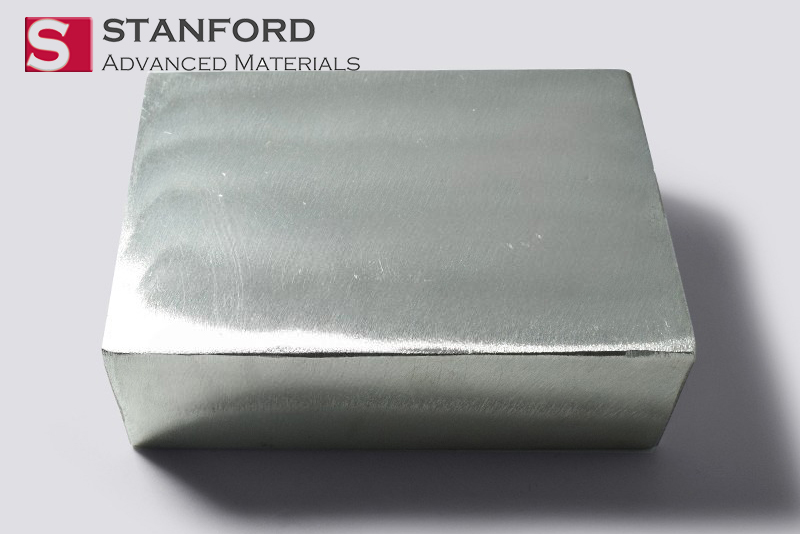
Our Aluminum Zinc Indium Silicon (AlZnInSi) planar targets represent a sophisticated material platform for depositing complex oxide or nitride films. This multi-principal element alloy serves as a versatile precursor for exploring novel Transparent Conductive Oxides (TCOs), high-performance diffusion barriers, and corrosion-resistant coatings through reactive sputtering.
| Material | AlZnInSi Quaternary Alloy |
| Composition | Al, Zn, In, Si (Ratios Customizable) |
| Typical Purity | ≥ 99.9% (Metal Basis, 4N) |
| Form | Planar Sputtering Target |
Key Advantage: A single target enabling the co-deposition of four critical elements, allowing rapid screening and optimization of complex multi-component oxide/nitride films (e.g., AZO, IZO, and their doped variants).
Customization: Elemental ratios (Al:Zn:In:Si), dimensions, and bonding fully customizable for your research or development needs.
Typical Applications: Research on next-generation TCOs (e.g., for displays, solar cells), high-entropy ceramic films, advanced diffusion barriers, and corrosion-resistant coatings.
For detailed evaluation and procurement (Standard Reference: ST11172).
| Parameter | Specification / Capability | Notes / Process Relevance |
|---|---|---|
| Material Type | Quaternary Alloy (Al-Zn-In-Si) | A precursor for complex oxide/nitride systems via reactive sputtering. |
| Composition Standard | Customizable (e.g., near-equimolar or biased toward specific TCO systems like Zn-rich for AZO or In-rich for IZO) | We tailor ratios to match your research objectives (e.g., exploring (Al,Zn,In,Si)Oₓ or (Al,Zn,In,Si)Nᵧ). |
| Base Purity | ≥ 99.9% (4N) on Metal Basis | High purity of constituent metals ensures clean film chemistry and reliable property evaluation. |
| Typical Density | ~4.5 – 6.0 g/cm³ (Alloy-dependent) | Achieved via vacuum melting or advanced powder metallurgy for homogeneity. |
| Microstructure | Homogeneous, Single-Phase or Fine Multi-Phase | Critical for uniform elemental emission during sputtering. Controlled via specialized metallurgy. |
| Standard Shape | Rectangular Planar Target | Circular and other geometries available. |
| Dimensions | Fully Customizable (Thickness ≥ 3mm recommended) | Sized for your research magnetron. |
| Sputtering Method | DC Magnetron (for metallic mode), Pulsed-DC or RF Reactive Sputtering | Ideal for reactive deposition in O₂/N₂/Ar atmospheres to form oxides or nitrides. |
| Bonding Options | Bonding to Cu/Mo backing plate available for improved heat dissipation. | Recommended for stable reactive sputtering processes. |
| Certification | Certificate of Composition (CoC) provided | Precise quantification of all four elements via ICP-MS or similar, with homogeneity mapping available. |
1. A Versatile Precursor for Complex Functional Oxides
This target is not for a single application but for materials discovery and optimization. It allows researchers to explore a vast compositional space in systems like:
2. The Challenge and Assurance of Homogeneity
Creating a homogeneous alloy from four elements with different melting points and mutual solubilities (e.g., Al/In) is a significant metallurgical challenge. SAM employs techniques like arc melting with repeated flipping or mechanical alloying followed by spark plasma sintering (SPS) to achieve a uniform, fine-grained microstructure. This ensures that the sputtered flux accurately represents the intended bulk composition.
3. Primary Research & Development Applications
Given the complexity, quality control is paramount. We provide a detailed Certificate of Composition (CoC) from inductively coupled plasma mass spectrometry (ICP-MS). Optional services include Electron Probe Microanalysis (EPMA) or WDS mapping to visually demonstrate elemental homogeneity across the target face, providing you with confidence in the reproducibility of your deposition experiments.
Discuss Your Project & Request a Custom Composition Quote
This is a collaborative development product. To proceed, please share: